
Mathías Fondo

MATHÍAS FONDO

Mathías Fondo

I am a PhD Candidate in Economics at the University of Bologna. My research lies at the intersection of applied microeconomics, public economics, and labor economics, exploring how public policies shape economic opportunities and inequality. My advisors are Giulio Zanella and Denni Tommasi.

My current projects focus on intergenerational social mobility in higher education, the labor market effects of minimum wages, and behavioral responses to income taxation.

Before starting my PhD, I earned my MSc and BS in Economics from Universidad de la República (Uruguay).

Contact: mathias.fondo@unibo.it

RESEARCH

Working Papers

Minimum Wages and the Distribution of the Firm Wage Premia
with Marcelo Bergolo, Rodrigo Ceni, and Damián VergaraSubmitted

NBER Working Paper No. 34188

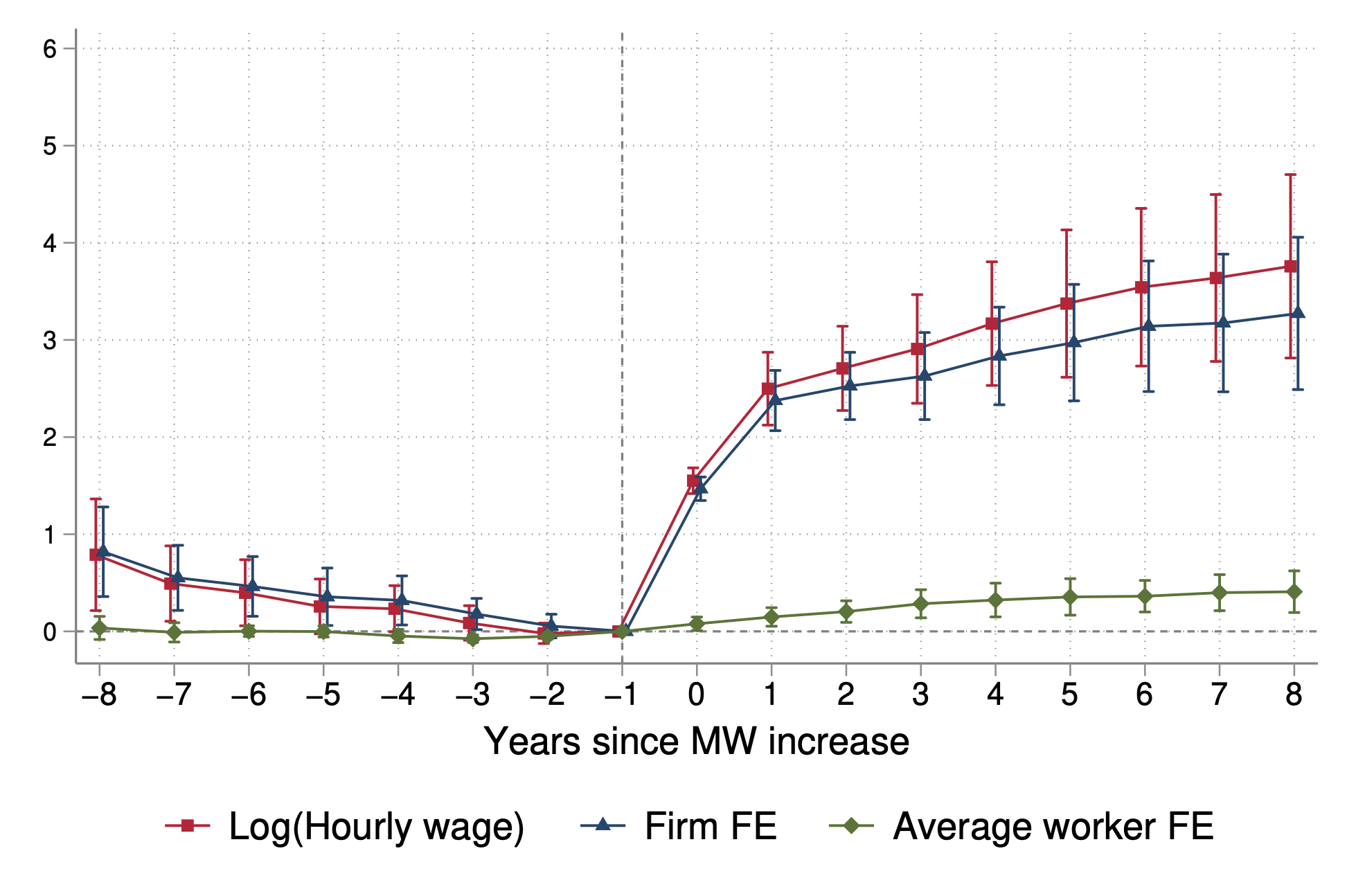
This paper leverages a large minimum wage reform in Uruguay to study the effects of minimum wages on the distribution of firm wage premia. The reform significantly decreased wage inequality, mainly by reducing between-firm inequality. AKM and time-varying AKM analyses reveal a large compression in the distribution of firm fixed effects after the reform, driven by an increase in the fixed effects of low-premium firms. Firm-level and worker-level difference-in-differences analyses document a causal effect of the reform on the compression of firm fixed effects. Results suggest minimum wages can increase the supply of "good jobs" by "making bad jobs better".
Figure 1

Work in Progress

Equal College, Unequal Payoffs: Student Employment, Major Choice, and the Persistence of Inequality

I study how upward socioeconomic mobility through higher education is constrained by mechanisms that operate after college enrollment and absent sorting into institutions of different quality. I exploit a unique setting in Uruguay, where a single, tuition-free, open-access public university accounts for 85% of total enrollment. Linking the universe of student academic records with high-frequency administrative labor histories, I first document that the intergenerational elasticity of earnings (IGE) remains highly persistent (0.17). I then show empirically that low-socioeconomic status (SES) students are constrained by two key mechanisms that shape their college trajectories: early employment during college, which penalizes academic performance, and sorting into lower-paying majors. Together with dropout and academic delay, these factors explain nearly two-thirds of the raw IGE. Finally, I develop and estimate a dynamic structural model of sequential college and labor supply decisions. The model reveals that disparities in pre-college ability act as the primary bottleneck to upward mobility. However, once early ability is equalized, financial constraints emerge as a binding secondary barrier that forces early unskilled labor, distorts major choice, and drives dropout decisions.

Asymmetric Responses to Labor Income Taxation
with Marcelo Bergolo

[Slides]

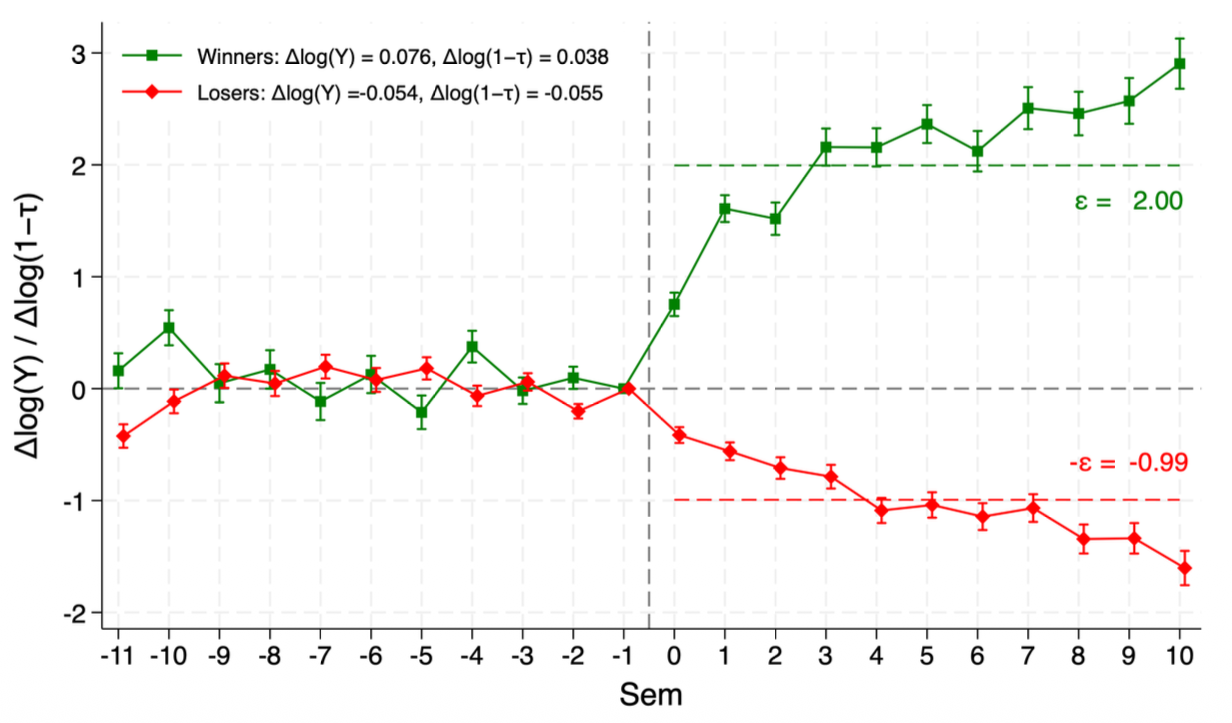
We investigate asymmetric behavioral responses to labor income taxation by exploiting Uruguay's massive 2007 reform, which transitioned the system from a flat to a progressive tax schedule. Using rich administrative records on the universe of formal workers in a difference-in-differences framework, we focus our analysis on the highest income quartile. We find that workers react more strongly to tax cuts than to tax increases. Specifically, the elasticity of reported income for "winners" (tax cuts) is roughly double the elasticity for "losers" (tax hikes). Furthermore, we demonstrate that job characteristics play a crucial role in these behavioral adjustments. The observed asymmetry is largely driven by workers who held multiple jobs prior to the reform and those with high work flexibility or income variance. Our findings highlight that assuming symmetric responses may mislead the evaluation of tax reforms.
Asymmetric Responses Figure

Grades, Academic Performance, and Labor Market Outcomes
with Rodrigo Nicolau and Joaquín PaleoDraft available upon request

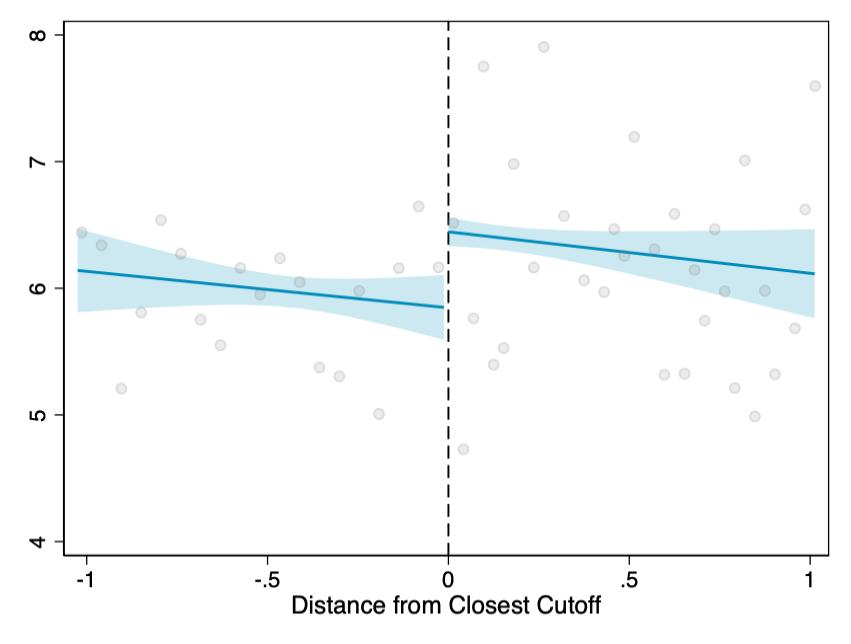
Grades open doors to scholarships, graduate programs, and jobs, but distinguishing the effect of grades from the underlying ability they measure is hard. We study this question by implementing a Regression Discontinuity Design around grade-jump cutoffs at Uruguay’s main higher education institution, where a deterministic rule converts continuous course scores into coarser transcript grades. Marginally earning a higher first-semester grade raises next-semester GPA by 0.23 standard deviations. Because students observe both the score and the grade, the response reflects the transcript label rather than anything students learn about their own ability. In the labor market, monthly earnings at the first job show no detectable change. In contrast, hourly wages are 17 to 21 percent higher, while weekly hours worked are 2.2 to 2.8 hours lower. The wage premium fades quickly, but the hours reduction persists. These findings seem to be driven by within-sector changes, rather than students sorting across sectors with systematically different jobs. A higher grade also raises public-sector entry by 7 percentage points, where hiring rules score GPA explicitly. Finally, among students who start working after the grade is realized, we find evidence that academic performance improves in the semesters after the first job begins, relative to students who marginally earned a lower grade, which is consistent with them working fewer hours.
GPA Next Semester RD Figure

Information about Relative Performance and Future Academic Achievement

with Rodrigo Nicolau and Joaquín Paleo

A student's rank among peers affects later achievement, but it is hard to disentangle why measures of relative performance might matter. In this paper we identify one component, the information a student receives about their relative standing. In our setting, course results are posted publicly as alphabetically ordered class rosters, so a student learns their own grade alongside the grades of their classmates. Two students earning the same grade in the same course, who happen to be surrounded by better or worse performing peers, see different signals about how well they did, for reasons unrelated to their own performance. Comparing such students, we find that earning the highest grade among one's nearest roster neighbours raises subsequent academic performance. The effect is unrelated to student characteristics, survives a randomization test that reshuffles roster order within each class, and is larger when a student outperforms a wider set of neighbours. These results show that information about relative performance, on its own, can affect students' future outcomes.

Pre-Doctoral Research

Transmisión intergeneracional de normas de género y participación de la mujer en el mercado de trabajo

with Cecilia Parada and Martina Querejeta (2024)

Investigaciones basadas en la Encuesta de Generaciones y Género. Uruguay 2022. Programa de Población (Udelar) / Banco Interamericano de Desarrollo.

Evolución de las principales variables del mercado laboral uruguayo (2016-2022)

with Paula Carrasco and Cecilia Parada (2023)

Documentos de Trabajo (working papers) 23-17, Instituto de Economía - IECON.

TEACHING

  • Econometrics
    Undergraduate level, University of Bologna (Feb 2025 - present)
  • Introduction to Machine Learning for Economists
    Master level, University of Bologna (Oct 2024 - present)
  • Data Mining and Machine Learning
    Undergraduate level, Johns Hopkins University (Feb 2025 - Apr 2025)
  • Industrial Organization
    Undergraduate level, Universidad de la República (Mar 2022 - Aug 2022)